 |
Already a member? Secure Login
|

Waist-to-Hip Ratios & Predicting Heart AttacksQUESTION:
I heard a recent report about waist-to-hip ratios predicting heart attacks. I have a family history of heart disease and am interested in learning more about my risks. Can you explain what this is all about? ANSWER:  Obesity has long been identified as a risk factor for cardiovascular disease and subsequent heart attacks. Health care providers have typically used a measurement called body mass index (BMI) to assess the level of obesity and thus cardiovascular disease risk. BMI is calculated by taking your weight in kilograms and dividing it by your height in meters squared (wt/ht2). However, BMI is increasingly being viewed as an obsolete method for assessing obesity as it relates to cardiovascular risk. More and more research is showing that the level of abdominal obesity is a better indicator of risk. A study published in the November issue of the Lancet looked at 27,098 people over 52 countries representing a good mix of various ethnic backgrounds. The results showed that waist-to-hip ratios (WHR) were significantly correlated with heart attack risk worldwide and that these ratios were a much better predictor than BMI. Obesity has long been identified as a risk factor for cardiovascular disease and subsequent heart attacks. Health care providers have typically used a measurement called body mass index (BMI) to assess the level of obesity and thus cardiovascular disease risk. BMI is calculated by taking your weight in kilograms and dividing it by your height in meters squared (wt/ht2). However, BMI is increasingly being viewed as an obsolete method for assessing obesity as it relates to cardiovascular risk. More and more research is showing that the level of abdominal obesity is a better indicator of risk. A study published in the November issue of the Lancet looked at 27,098 people over 52 countries representing a good mix of various ethnic backgrounds. The results showed that waist-to-hip ratios (WHR) were significantly correlated with heart attack risk worldwide and that these ratios were a much better predictor than BMI.This means that the area in which you carry your extra fat is important to your health. Although women who carry their extra weight in their hips and thighs may dislike their shape (i.e., pear shape), from a health perspective they are much luckier than those individuals who carry their extra weight around the mid-section or abdominal region (i.e., apple shape or android obesity). To figure your waist-to-hip ratio, measure your waist with a non-stretchable tape measure at the narrowest point between the bottom of your ribcage and your hip bones. Tension should be firm but not pulled so tight as to compress the tissue underneath. Record this measurement. Next, measure your hips at the widest point around the buttocks region. Divide your waist measurement by your hip measurement to obtain your ratio. Although firm guidelines will most likely surface soon, a general consensus on the desired ratio is less than 1.0 for males and less than 0.8 for females. Waist-to-Hip Ratio Calculator 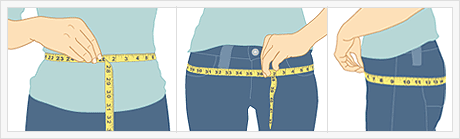
Our expert, Dr. Sharon E. Griffin, holds a B.S., M.S., and Ph.D. in the areas of exercise science/physiology. She also holds a second M.S. degree in Nutrition and is a licensed nutritionist and an ACSM certified health and fitness instructor.
|







© 2024 MyFoodDiary.com. All Rights Reserved.