 |
Already a member? Secure Login
|

Abdominal Exercise FrequencyQUESTION:
I've heard conflicting information on abdominal exercises. Can I do AB exercises every day or not? ANSWER: 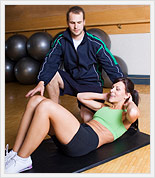 Ideally, abdominal muscles should be trained in a similar fashion to other muscles of the body, allowing 48 hours rest between workouts. Performing abdominal exercises on a daily basis increases the risk of incomplete recovery and adaptation of the muscles. The days of doing hundreds of crunches are behind us and we now know that quality training is better than quantity training. This allows us to spend less time overall "working" the abdominal region and instead, strategically targeting the various abdominal muscles using a wide variety of exercises that typically only need 15-20 repetitions each. A good abdominal program will include exercises that target all of the various muscles of the region including the rectus abdominis, internal and external obliques, and the transversus abdominis. In addition, the program will utilize a variety of movements including extension, flexion and rotation. An exercise specialist will be able to guide you through various exercises, instructing you on proper form so that compression of the lower back is avoided. This type of "smart" training will produce results in less time, and avoid injury to your lower back. Ideally, abdominal muscles should be trained in a similar fashion to other muscles of the body, allowing 48 hours rest between workouts. Performing abdominal exercises on a daily basis increases the risk of incomplete recovery and adaptation of the muscles. The days of doing hundreds of crunches are behind us and we now know that quality training is better than quantity training. This allows us to spend less time overall "working" the abdominal region and instead, strategically targeting the various abdominal muscles using a wide variety of exercises that typically only need 15-20 repetitions each. A good abdominal program will include exercises that target all of the various muscles of the region including the rectus abdominis, internal and external obliques, and the transversus abdominis. In addition, the program will utilize a variety of movements including extension, flexion and rotation. An exercise specialist will be able to guide you through various exercises, instructing you on proper form so that compression of the lower back is avoided. This type of "smart" training will produce results in less time, and avoid injury to your lower back.
Our expert, Dr. Sharon E. Griffin, holds a B.S., M.S., and Ph.D. in the areas of exercise science/physiology. She also holds a second M.S. degree in Nutrition and is a licensed nutritionist and an ACSM certified health and fitness instructor.
|







© 2025 MyFoodDiary.com. All Rights Reserved.