 |
Already a member? Secure Login
|

- Ideal Weight Calculator
- Waist-to-Hip Ratio Calculator
- BMI Calculator
- Frame Size Calculator
- Target Heart Rate Calculator

- Good Fast Food
- Recipe Makeovers
- Meal Plans
- Nutrient Facts
- Food Label Claims
- Estimating Serving Sizes




Lose Fat and Gain Muscle
QUESTION:
I would like to lose fat and gain muscle. It is my understanding that I need a calorie surplus to gain muscle and a calorie deficit to lose fat. How can I achieve both of my goals?
I would like to lose fat and gain muscle. It is my understanding that I need a calorie surplus to gain muscle and a calorie deficit to lose fat. How can I achieve both of my goals?
ANSWER:
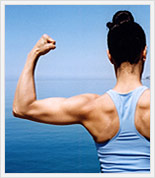 Great question! The bottom line is that our bodies are amazing and the body can easily handle losing fat tissue and building muscle at the same time. There are a couple things, however, that you should monitor to ensure a smooth process: calorie intake and protein intake. The body requires both to build new muscle.
Calorie Intake
Protein synthesis (i.e., muscle building) requires a lot of energy (i.e., calories). Therefore, you need to make sure that you are eating enough calories. However, eating too many calories will prevent the fat loss that you are aiming for. How do we strike the balance? Your body will be able to use the energy from the metabolism of body fat to build new muscle mass. In other words, you do not need as much of a calorie surplus as you might think.
Assuming that your normal caloric intake is adequate, you can start by simply adding strength training to your routine. If the desired fat loss is not occurring, slowly decrease your caloric intake by 100 calories per day. If you feel weak and lethargic, then you have reduced your calories too much and you will need to slightly increase your calories until you feel strong and energetic again. Give each new calorie adjustment 3-5 days before changing it. This gives you enough time to assess your energy level correctly.
Protein Intake
Although our bodies can use energy from burning other tissues (e.g., fat), it cannot provide all of the amino acids (the building blocks of muscle) needed to build muscle. Therefore, it is very important that you make sure that you are getting adequate and varied protein in your diet. Note that "adequate" protein does not mean "excessive" protein! There is no need to supplement normal dietary protein with expensive protein supplements. Most likely you will need somewhere between 0.8 and 1.7 g of protein per kilogram of body weight per day, which is easily attained through normal food intake. Remember to vary your protein types to ensure that you are getting all of the necessary essential amino acids in your diet. In addition, choose protein sources that are low in saturated fat such as:
- Tempeh
- Tofu
- Skim yogurt
- Nonfat, dry milk
- Beans and legumes
- Hummus
- Nuts and seeds
- Eggs
- Poultry and Fish
Lastly, ingest some of your daily calories in the form of mixed protein and carbohydrate snack foods immediately before and after your workouts. This will help replenish glycogen stores and aid muscle building.
Good luck!
Don't forget that you can use MyFoodDiary.com to track both your calorie and protein intake.
 |
| Related Articles: |
|
 |
Our expert, Dr. Sharon E. Griffin, holds a B.S., M.S., and Ph.D. in the areas of exercise science/physiology. She also holds a second M.S. degree in Nutrition and is a licensed nutritionist and an ACSM certified health and fitness instructor.
© 2025 MyFoodDiary.com. All Rights Reserved.