 |
Already a member? Secure Login
|

- Ideal Weight Calculator
- Waist-to-Hip Ratio Calculator
- BMI Calculator
- Frame Size Calculator
- Target Heart Rate Calculator

- Good Fast Food
- Recipe Makeovers
- Meal Plans
- Nutrient Facts
- Food Label Claims
- Estimating Serving Sizes




Butter vs. Margarine
QUESTION:
I'm confused as to what type of buttery spread I should use. Which is better, butter or margarine?
I'm confused as to what type of buttery spread I should use. Which is better, butter or margarine?
ANSWER:
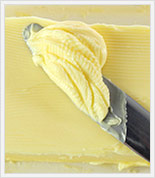 This has been a confusing issue over the decades. There was a time when the focus was simply to reduce saturated fat. The recommendation was to replace butter (saturated fat) with margarine (unsaturated fat). However, we now know that the trans fats in margarine are even worse than saturated fats. Trans fats can increase bad cholesterol (LDL), decrease good cholesterol (HDL) and may even contribute to metabolic disorders.
Luckily, today there are more choices available to consumers than ever before. Many of today's spreads contain no trans fat and some brands have even added Omega 3 fatty acids -- an important healthy fat. Check the label and make sure that the spread you choose is trans fat free. Some common brands are Earth Balance and Smart Balance. I recommend that you avoid margarine and instead use these types of spreads. In addition, I feel that butter is better than hydrogenated margarines, but it should still be used sparingly as it is high in saturated fat.
The best scenario is to replace your buttery spread with olive oil when possible. There's nothing like fresh baked bread dipped in herbed olive oil!
In summary:
- Avoid hydrogenated margarine
- Use butter sparingly
- Choose spreads that are non-hydrogenated and trans fat free
- When feasible, use high-quality vegetable oils instead of spreads
 |
| Related Articles: |
|
 |
Our expert, Dr. Sharon E. Griffin, holds a B.S., M.S., and Ph.D. in the areas of exercise science/physiology. She also holds a second M.S. degree in Nutrition and is a licensed nutritionist and an ACSM certified health and fitness instructor.
© 2026 MyFoodDiary.com. All Rights Reserved.